
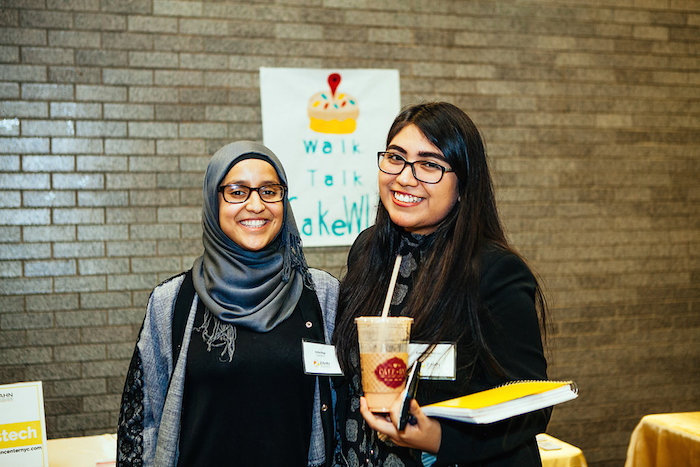
With Demo Day coming soon, we’d like to introduce you to some of our startups competing for seed funding totaling $150,000. Like many of our startups, CakeWLK is using modern technology to solve a societal issue. They’re creating a digital version of the buddy system–an app that connects college students who feel unsafe during their commute to school, or their walk from class to the dorms.
I sat down with two members of the team to talk about how they came up with this idea, and what drives their passion for advocating for safety. CakeWLK is made up of Ashia Nagi, a junior studying applied mathematics at CCNY, Saad Ahmed, a sophomore computer science major at CCNY; and CUNY students Estefanía Barrón, computer science; and Frances Shnaidman, computer science and journalism. This is how they got started:

Ashia Nagi: The funny story is that we met at Technica (an all women hackathon). Most people go to it with a team, but I ended up going alone. I was really close to not going, but something told me to try it anyway. I met Estefanía and Francis, and they proposed CakeWLK. I thought the problem behind it was so cool–we all feel unsafe sometimes, and to help think about a way to solve feeling unsafe as a college student. We met, and now we’re here. Even though we didn’t win the hackathon, I told them about the Zahn Center’s competition. We stayed up for two days, but it was all because we realized this is something that I want to pursue.
Estefanía Barrón: That hackathon was my first experience with computer science. It was super intimidating. But I had the idea for the app for awhile. I thought, what if you could find a walking buddy for your commute home? I pitched it to Francis, and then we met Ashia and it was cool to meet people that were just as passionate about it.
Katherine Olives: I mean it’s definitely a huge problem–I hardly ever feel safe when I walk alone. It’s incredible that you’re trying to tackle this issue.
AN: There’s this constant trend of people getting harassed alone and not being able to report it to school–often there’s no evidence. With CakeWLK, there’s proof they were walking a certain route, there’s a certain record of what happened. It could be potentially helpful in situations like this. We don’t want anyone to live in fear while they’re getting an education. You wouldn’t believe what we found in our research–in some cases, there are more instances of crime within a campus than in the community that surrounds it. Data like that puts everything we do into perspective.
EB: I grew up in the most dangerous city in Mexico–it’s a place where women disappear all the time. I was not allowed to walk home from school alone (even though I only lived about two blocks away). I usually had to wait for my male cousins to pick me up and walk me home. I remember that when I was younger there was a seven year old girl who went missing and was found brutally murdered. It turns out she walked the three blocks home from school at 4pm–in broad daylight–and was never seen alive ever again. When I came here, I thought things would be different. But I often don’t feel any safer in the US, a first world country. I thought to myself, if I don’t do anything about this, no one else will.
KO: Wow. I don’t even know what to say. You’re helping so many people. Are the customers you interviewed excited?
AN: The craziest thing is that students are excited for this app. We’re getting so much support. At our tabling events, students will stick around and talk about the experiences they’ve had. It’s inspiring.
KO: Does that keep you going?
AN: Absolutely. We get really stressed, but it’s the feedback from students and colleges that keeps us going. It’s almost like we’re not in this alone. It’s been so amazing. I can’t describe how good that feels.
EB: I love when I get validation from people who aren’t students, or students who don’t go to CCNY. People want to help, they’re always like “let me find people for you.” It’s so empowering. People want it, and they’re helping us to make CakeWLK a reality.
AN: We had one meeting with a Chancellor and he connected us to someone from Duke University–everyone has been very helpful so far.
KO: It sounds like you’re getting so many positive reactions! That’s so great. But there must be some challenges. Tell me about that.
AN: It’s been challenging working with friends. It’s hard to let people down, to give harsh criticism, because it always seems a bit personal. Plus, while a lot of the interactions we’ve had are positive, some of them are not. We’ve had experiences working with individuals who aren’t as passionate as we are. I feel like when a person isn’t passionate, it drags down the whole team. It creates negative energy–it makes everything harder to accomplish. That’s a hard lesson I had to learn. You might work with really talented people, but if they don’t care about the problem, chances are they won’t apply creativity to their work.
EB: There’s a lot of technical issues that we’re going through right now. My desire and ideas are bigger than my skills, so it’s really frustrating. I often think, I want to add this feature, but can I actually make it happen? When that happens I just say “yes I want to make this happen and I will, but I’m going to need a little bit of time.” I can’t always deliver immediately, but I’ll figure it out. “Fake it till you make it, right.” I’ve been living that motto!
AN: Hahaha exactly! We’re learning as we go. Youtube is our best friend. But honestly, it shows the passion for this problem. I honestly think that we think intelligently, we figure out ways to get around obstacles, and we work with the skills we have now. And honestly, a practical education is the best way to learn coding.
KO: That’s really great advice. Many students or other young people don’t think that they have the skills to become an entrepreneur. But a lot of it is a learning experience. Do you have any other advice for students?
AN: Yes! I’m always giving people advice haha. I’m doing things on my own, no one is guiding me, so I like to share what I learn.
KO: Give us your advice, Ashia!
AN: Okay so there are two things. In the tech realm I’ve received so much backlash from my community and teachers. So many people think that your current skill set is a determining factor. Skills can be acquired. If someone is saying, “Oh I’m bad at Math, I shouldn’t do this,” that’s ridiculous. Why are you in college? TO LEARN. Are you passionate about Math? That passion will see you through.
EB: My biggest piece of advice: there is a place for you. I feel like in computer science or engineering, it’s easy to think that you have to look a certain way or be a certain way to have a place in the classroom. There is a space for you and you deserve it as much as anyone else. More advice: remember that you’re growing. Don’t be someone that you’re not. Skills without passion are meaningless. You can’t teach someone how to feel something, it’s there or it’s not. Whatever skill you have, it’s going to be meaningless. Do it with your heart, do it because you feel it.
AN: I know a lot of people won’t listen to us–I don’t really listen to advice either because often it’s so abstract. You just have to experience it. We all cried a little, we drank 25 coffees in one day, we did whatever we had to do to not give up. I’m not gonna give up, and neither should any of you.
KO: You here that, City College? Will you be sharing more advice at Demo Day, or just your MVP?
AN: I want people to sign up for our web app at Demo Day! If you’re a college student who’s excited about this idea, take part in the beta test. You can be part of the creation of CakeWLK. Besides that, we’re open to all feedback. Let us know what you think!
Share your thoughts with CakeWLK & sign up on their website. You’ll see them at Demo Day!


