With Demo Day only a week away, we’re thrilled to introduce you to some of our startups competing this year! Remember, the power is in your hands on Demo Day. YOU decide who gets the Audience Choice Awards.
Today you’ll meet FloraMind, a team dedicated to breaking the stigma around mental health. They’re helping teens understand mental health, learn how to identify warning signs, and build resilience through workshops and well-being exercises. This seems especially important in a society categorized by mass shootings & social media-induced depression. I sat down with the FloraMind team–made up of CCNY undergrads Khandker Ahamed, a Digital Product Marketing major; Mahmoud Khedr, an Applied Psych major; and Danny Tsoi, an Economics major. This is how they got started:
Katherine Olives: So happy to get to sit down with you, FloraMind! (Love the new name.) So when you entered the competition, you were building an AI-powered app to help people cope with depression and anxiety. I’m excited to hear more about have you’ve re-positioned yourselves!
Mahmoud Khedr: We were trying to build a chatbot that would help individuals with depression, but since then we’ve pivoted–mostly by understanding the end user. There are plenty of products and services out there that help individuals overcome depression or anxiety, but there’s still one major underlying issue: a lack of understanding of mental health issues. Through our research we learned that fifty percent of mental health disorders develop at age fourteen, but there isn’t a curriculum around mental health. Some schools don’t even have counselors on staff, and when they have counselors, these counselors are trained to help students work on their grades and pick colleges, not help them overcome mental health issues.
Danny Tsoi: We saw this as a gap–a way to give educators what they need.
MK: There’s an average of one social worker for every 600 students. We have more school security guards than that. To me, that means we’re very much focused on the effects of mental health disorders, rather than the cause. One in four teenagers will experience a mental health episode in a given year; one in twelve will attempt suicide. How is this happening? Schools don’t invest in mental health; and some don’t want to talk about it at all.
KO: It’s really amazing that you’ve decided to tackle this problem. What makes your team so connected to it?
Khandher Ahamed: Everyone on our team has faced a mental health issue at some point in our lives. We know first hand and relate to a certain extent. We feel more and more of a need to get up and get out there and actually execute.
MK: We actually did our first workshop yesterday at Medgar Evers Prep. We wanted to start at our own high schools, so we connected with one of the teachers there and she helped us set up the event and share it with the students there.
KO: That’s awesome! What was the workshop about?
MK: We worked on the social stigma of mental health. A lot of people think mental health is a taboo subject, so this workshop was designed to break that. We discussed what you should talk about, who you should talk to, and what you should worry about when it comes to mental health.
DT: We also introduced meditation and the students loved it. Our goal is to not just educate young people about mental health, but introduce them to well-being exercises. We hope that they’ll be able to recognize warning signs within themselves, their family, and friends. It’ll also help them develop resilience.
KO: Did the students like it?
DT: They loved it. It’s so great to know that the students were engaged and enjoyed the activity–it means they’re invested in emotional regulation.
KA: When we asked for feedback at the end, they said that the whole workshop helped them learn more and understand how to talk about these topics. It’s a good feeling.
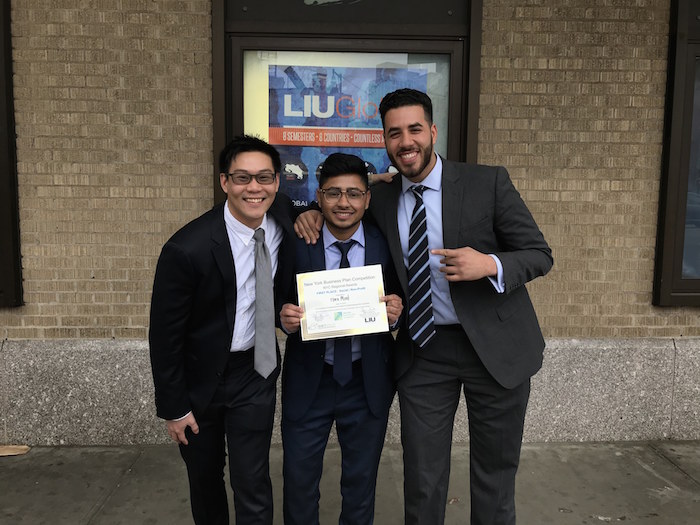
MK: It’s super exciting that we’re getting validations from customers. The next step is to get validation from others. We’re going to be in Albany this week–Thursday and Friday–for the New York State Business Plan Competition. We’re competing against 120 other teams, and we’re so excited to share our ideas.
KO: I’m sure you’ll all rock it. It sounds like you’re getting a lot of positive feedback–is there anything that’s challenging you right now?
MK: Mental health is such a big field and a big problem–I fear that it’s hard for us to create impact. There’s also a lot of research that goes into trying to understand the field. None of us are psychologists. We had struggles when we were pivoting, trying to understand what individuals really needed. And of course there are challenges that come with working with best friends. We’ve had to figure out what our workflow is, and how to convert from friend to team member.
KA: Another challenge is that people just don’t like to talk about mental health. It’s hard to stay focused on this problem when everyone keeps pushing it under the rug. There’s a huge stigma we have to break.
DT: That’s one of the reasons why we picked reducing social stigma as our first topic. It’s the most difficult thing to do, but it needs to happen. You won’t be open to mental health education if that stigma isn’t broken first. This is where we see that we can create the most impact.
MK: We worked with twenty-two students in our first workshop, and that’s twenty-two individuals who are now more open to talking about mental health. In the future we’d like to engage parents and educators as well.
DT: We’re stepping up and showing the value of mental health education. It’s almost like this type of curriculum prepares you to be a human being. I wish I had something like this when I was in high school!
KA: Right?! High school puts a lot of pressure on you–you have to get good grades, be social, do sports, give back to your community, get into college–but no one teaches you how to deal with that pressure. As you go on in life the stress just gets worse. No one’s teaching you how to deal with that. People wonder why kids resort to drugs–they end up resorting to bad habits to deal with the stress instead of developing good habits.
DT: Plus, for years now, high school students have known that getting a college degree doesn’t mean that you’ll get a job. That’s not what our parents dealt with. It’s a hard reality to face.
MK: And they’re affected by social media. High school students feel like they have to be perfect–on- and offline. There’s this notion that you have to maintain a flawless Instagram-worthy life, and this carries over into our normal lives.
KO: Kids need to have allies, but they also need to know that they are their own biggest allies. I think you’re giving them the tools to understand that. I can’t wait to find out how you do in Albany!
MK: Us too! We’re also pitching in front of judges at Echoing Green soon–we’re social innovation finalists, which means we can be fast tracked into their program.
KO: That’s so exciting! We’re sending all the positive vibes!
Send more positive vibes FloraMind’s way by following them on Instagram @flora.mind & checking out their website. They’re looking to connect with high schools, educators, and psychologists. You can meet them in person at Demo Day on Monday.